Einstein Model of a Solid
A crystal as an array of P atoms held on a lattice, each modeled as quantum harmonic oscillators carrying a whole number of energy quanta (Q in total). In one dimension each atom is a single oscillator, so N = P; in the full three-dimensional solid each atom is three independent x/y/z oscillators, so N = 3P. The quanta are Boltzmann-distributed and hop between oscillators at random times with the total conserved — so you watch a closed system relax to, and fluctuate around, thermal equilibrium. Four complementary windows into the model:
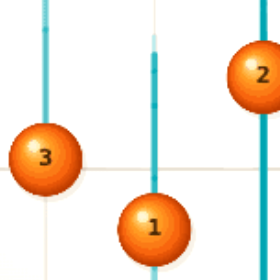
The classic “Q quanta among N oscillators” counting picture. In 1-D each atom is one oscillator, so N = P. Set Q and N by hand and read entropy and temperature straight off the multiplicity Ω = C(Q+N−1, Q).
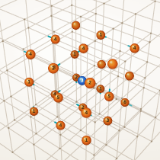
The full N = 3P Einstein solid, drawn as a cubic array of P atoms (three x/y/z oscillators each) with the Q quanta Boltzmann-distributed at a temperature you set and exchanged at random. View it on-axis for a clean read or as the realistic 3-D orbit.
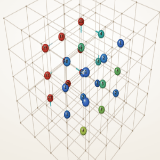
The same N = 3P array, knocked out of equilibrium. Inject energy into an atom or load a hot face, then watch it diffuse back while a live entropy readout climbs toward its ceiling — the Second Law, frame by frame.
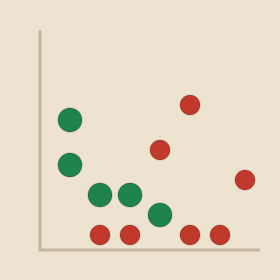
The bookkeeping behind the entropy, made explicit. Browse every configuration and its microstate count, and watch the Boltzmann distribution emerge as the average occupancy over all microstates.
DETAILS · THE PHYSICS
Frequency is shared by every oscillator and independent of energy (isochronous); amplitude grows as the quantum turning point √(2n+1); exchange is discrete, conserved and “well-stirred”, with the Boltzmann distribution as its stationary state. Units are illustrative — the statistics are faithful. Temperature itself is defined from entropy, not the other way around: put two systems in contact at fixed total energy, and the shared quantity that equalizes at equilibrium (where the total microstate count is maximized) is 1/T ≡ ∂S/∂E — it tracks energy per particle only when the level spacing is small relative to kT. full derivation of T = dE/dS →
DETAILS · THE ANIMATION
This is a classical depiction of a quantum system. The energy quantization, the zero-point swing (∝ √(2n+1)), the shared frequency and the statistics are all faithful — but the bouncing balls are a teaching device. A real oscillator in an energy eigenstate is a stationary state: its probability cloud does not slosh back and forth (⟨x⟩ = 0 for all time), and the atom has no single position. The smooth sinusoidal motion you see is a classical stand-in whose amplitude encodes the quantum energy level — chosen so that “more energy” reads at a glance. A literal depiction would replace each ball with a static, fuzzy |ψₙ(x)|² density that widens and grows lobes as n rises. On screen the ground-state swing runs about 0.02 – 0.2 of the lattice spacing: the low end (~2%) is roughly what a real crystal shows, while the upper end is exaggerated for visibility — approaching the regime of genuine quantum solids like solid helium.
DETAILS · DEVELOPMENT OF THIS SET OF TEACHING TOOLS
These four tools were built iteratively in conversation with Claude, starting from a single 3-D animation and growing outward as questions arose: why do low- and high-energy oscillators appear to move at the same rate, does re-thermalization conserve energy, why does a Boltzmann distribution peak away from zero energy. Each answer became a fix, a caption, or a new panel — the 1-D counting model and Microstates browser exist specifically to make the entropy bookkeeping behind the animations checkable by hand. The physics was checked against known results at each step (multiplicities, the geometric occupancy distribution, T = dE/dS) rather than assumed correct because the animation looked right.